About Me

My photo
Lift your lamp beside the golden door, Break not the golden rule, avoid well the golden calf, know; not all that glitters is gold, and laissez faire et laissez passer [let do and let pass] but as a shining sentinel, hesitate not to ring the bell, defend the gates, and man the wall

Monday, January 30, 2012

Israeli PM Benjamin Netanyahu's Speech To Congress May 24 2011

At the Joint Session of Congress 
I am deeply honored by your warm welcome. And I am deeply honored that you have given me the opportunity to address Congress a second time. Mr. Vice President, do you remember the time we were the new kids in town? And I do see a lot of old friends here. And I do see a lot of new friends of Israel here. Democrats and Republicans alike.
Israel has no better friend than America. And America has no better friend than Israel. We stand together to defend democracy. We stand together to advance peace. We stand together to fight terrorism. Congratulations America, Congratulations, Mr. President. You got bin Laden. Good riddance.
In an unstable Middle East, Israel is the one anchor of stability. In a region of shifting alliances, Israel is America’s unwavering ally. Israel has always been pro-American. Israel will always be pro-American.
My friends, you don’t need to do nation building in Israel. We’re already built. You don’t need to export democracy to Israel. We’ve already got it. You don’t need to send American troops to defend Israel. We defend ourselves. You’ve been very generous in giving us tools to do the job of defending Israel on our own. Thank you all, and thank you President Obama, for your steadfast commitment to Israel’s security. I know economic times are tough. I deeply appreciate this.
Support for Israel’s security is a wise investment in our common future. For an epic battle is now unfolding in the Middle East, between tyranny and freedom. A great convulsion is shaking the earth from the Khyber Pass to the Straits of Gibraltar. The tremors have shattered states and toppled governments. And we can all see that the ground is still shifting. Now this historic moment holds the promise of a new dawn of freedom and opportunity. Millions of young people are determined to change their future. We all look at them. They muster courage. They risk their lives. They demand dignity. They desire liberty.
These extraordinary scenes in Tunis and Cairo, evoke those of Berlin and Prague in 1989. Yet as we share their hopes, but we also must also remember that those hopes could be snuffed out as they were in Tehran in 1979. You remember what happened then. The brief democratic spring in Iran was cut short by a ferocious and unforgiving tyranny. This same tyranny smothered Lebanon’s democratic Cedar Revolution, and inflicted on that long-suffering country, the medieval rule of Hezbollah.
So today, the Middle East stands at a fateful crossroads. Like all of you, I pray that the peoples of the region choose the path less travelled, the path of liberty. No one knows what this path consists of better than you. This path is not paved by elections alone. It is paved when governments permit protests in town squares, when limits are placed on the powers of rulers, when judges are beholden to laws and not men, and when human rights cannot be crushed by tribal loyalties or mob rule.
Israel has always embraced this path, in the Middle East has long rejected it. In a region where women are stoned, gays are hanged, Christians are persecuted, Israel stands out. It is different.
As the great English writer George Eliot predicted over a century ago, that once established, the Jewish state will “shine like a bright star of freedom amid the despotisms of the East”. Well, she was right. We have a free press, independent courts, an open economy, rambunctious parliamentary debates.You think you guys are tough on one another in Congress? Come spend a day in the Knesset. Be my guest.
Courageous Arab protesters, are now struggling to secure these very same rights for their peoples, for their societies. We’re proud that over one million Arab citizens of Israel have been enjoying these rights for decades. Of the 300 million Arabs in the Middle East and North Africa, only Israel’s Arab citizens enjoy real democratic rights. I want you to stop for a second and think about that. Of those 300 million Arabs, less than one-half of one-percent are truly free, and they’re all citizens of Israel.
This startling fact reveals a basic truth: Israel is not what is wrong about the Middle East. Israel is what is right about the Middle East.
Israel fully supports the desire of Arab peoples in our region to live freely. We long for the day when Israel will be one of many real democracies in the Middle East. Fifteen years ago, I stood at this very podium, and said that democracy must start to take root in the Arab World. Well, it’s begun to take root. This beginning holds the promise of a brilliant future of peace and prosperity. For I believe that a Middle East that is genuinely democratic will be a Middle East truly at peace.
But while we hope and work for the best, we must also recognize that powerful forces oppose this future.They oppose modernity. They oppose democracy. They oppose peace. Foremost among these forces is Iran. The tyranny in Tehran brutalizes its own people. It supports attacks against American troops in Afghanistan and Iraq. It subjugates Lebanon and Gaza. It sponsors terror worldwide.
When I last stood here, I spoke of the dire consequences of Iran developing nuclear weapons. Now time is running out, and the hinge of history may soon turn. For the greatest danger facing humanity could soon be upon us: A militant Islamic regime armed with nuclear weapons.
Militant Islam threatens the world. It threatens Islam. I have no doubt that it will ultimately be defeated. It will eventually succumb to the forces of freedom and progress. But like other fanaticisms that were doomed to fail, militant Islam could exact a horrific price from all of us before its inevitable demise.
A nuclear-armed Iran would ignite a nuclear arms race in the Middle East. It would give terrorists a nuclear umbrella. It would make the nightmare of nuclear terrorism a clear and present danger throughout the world. I want you to understand what this means. They could put the bomb anywhere. They could put it on a missile. It could be on a container ship in a port, or in a suitcase on a subway.
Now the threat to my country cannot be overstated. Those who dismiss it are sticking their heads in the sand. Less than seven decades after six million Jews were murdered, Iran’s leaders deny the Holocaust of the Jewish people, while calling for the annihilation of the Jewish state.
Leaders who spew such venom, should be banned from every respectable forum on the planet. But there is something that makes the outrage even greater: The lack of outrage. In much of the international community, the calls for our destruction are met with utter silence. It is even worse because there are many who rush to condemn Israel for defending itself against Iran’s terror proxies.
But not you. Not America. You have acted differently. You’ve condemned the Iranian regime for its genocidal aims. You’ve passed tough sanctions against Iran. History will salute you, America.
President Obama has said that the United States is determined to prevent Iran from developing nuclear weapons. He successfully led the Security Council to adopt sanctions against Iran. You in Congress passed even tougher sanctions. These words and deeds are vitally important.
Yet the Ayatollah regime briefly suspended its nuclear program only once, in 2003, when it feared the possibility of military action. That same year, Muammar Qadaffi gave up his nuclear weapons program, and for the same reason. The more Iran believes that all options are on the table, the less the chance of confrontation. This is why I ask you to continue to send an unequivocal message: That America will never permit Iran to develop nuclear weapons.
As for Israel, if history has taught the Jewish people anything, it is that we must take calls for our destruction seriously. We are a nation that rose from the ashes of the Holocaust. When we say never again, we mean never again. Israel always reserves the right to defend itself.
My friends, while Israel will be ever vigilant in its defense, we will never give up on our quest for peace. I guess we’ll give it up when we achieve it. Israel wants peace. Israel needs peace. We’ve achieved historic peace agreements with Egypt and Jordan that have held up for decades.
I remember what it was like before we had peace. I was nearly killed in a firefight inside the Suez Canal. I mean that literally. I battled terrorists along both banks of the Jordan River. Too many Israelis have lost loved ones. I know their grief. I lost my brother.
So no one in Israel wants a return to those terrible days. The peace with Egypt and Jordan has long served as an anchor of stability and peace in the heart of the Middle East.
This peace should be bolstered by economic and political support to all those who remain committed to peace.
The peace agreements with Egypt and Jordan are vital. But they’re not enough. We must also find a way to forge a lasting peace with the Palestinians. Two years ago, I publicly committed to a solution of two states for two peoples: A Palestinian state alongside the Jewish state.
I am willing to make painful compromises to achieve this historic peace. As the leader of Israel, it is my responsibility to lead my people to peace. This is not easy for me. I recognize that in a genuine peace, we will be required to give up parts of the Jewish homeland. In Judea and Samaria, the Jewish people are not foreign occupiers. We are not the British in India. We are not the Belgians in the Congo.
This is the land of our forefathers, the Land of Israel, to which Abraham brought the idea of one God, where David set out to confront Goliath, and where Isaiah saw a vision of eternal peace. No distortion of history can deny the four thousand year old bond, between the Jewish people and the Jewish land.
But there is another truth: The Palestinians share this small land with us. We seek a peace in which they will be neither Israel’s subjects nor its citizens. They should enjoy a national life of dignity as a free, viable and independent people in their own state. They should enjoy a prosperous economy, where their creativity and initiative can flourish.
We’ve already seen the beginnings of what is possible. In the last two years, the Palestinians have begun to build a better life for themselves. Prime Minister Fayad has led this effort. I wish him a speedy recovery from his recent operation. We’ve helped the Palestinian economy by removing hundreds of barriers and roadblocks to the free flow of goods and people. The results have been nothing short of remarkable. The Palestinian economy is booming. It’s growing by more than 10% a year.
Palestinian cities look very different today than they did just a few years ago. They have shopping malls, movie theaters, restaurants, banks. They even have e-businesses. This is all happening without peace. Imagine what could happen with peace. Peace would herald a new day for both peoples. It would make the dream of a broader Arab-Israeli peace a realistic possibility.
So now here is the question. You have to ask it. If the benefits of peace with the Palestinians are so clear, why has peace eluded us? Because all six Israeli Prime Ministers since the signing of Oslo accords agreed to establish a Palestinian state. Myself included. So why has peace not been achieved? Because so far, the Palestinians have been unwilling to accept a Palestinian state, if it meant accepting a Jewish state alongside it.
You see, our conflict has never been about the establishment of a Palestinian state. It has always been about the existence of the Jewish state. This is what this conflict is about. In 1947, the United Nations voted to partition the land into a Jewish state and an Arab state. The Jews said yes. The Palestinians said no. In recent years, the Palestinians twice refused generous offers by Israeli Prime Ministers, to establish a Palestinian state on virtually all the territory won by Israel in the Six Day War.
They were simply unwilling to end the conflict. And I regret to say this: They continue to educate their children to hate. They continue to name public squares after terrorists. And worst of all, they continue to perpetuate the fantasy that Israel will one day be flooded by the descendants of Palestinian refugees.
My friends, this must come to an end. President Abbas must do what I have done. I stood before my people, and I told you it wasn’t easy for me, and I said – “I will accept a Palestinian state”. It is time for President Abbas to stand before his people and say – “I will accept a Jewish state”.
Those six words will change history. They will make clear to the Palestinians that this conflict must come to an end. That they are not building a state to continue the conflict with Israel, but to end it. They will convince the people of Israel that they have a true partner for peace. With such a partner, the people of Israel will be prepared to make a far reaching compromise. I will be prepared to make a far reaching compromise.
This compromise must reflect the dramatic demographic changes that have occurred since 1967. The vast majority of the 650,000 Israelis who live beyond the 1967 lines, reside in neighborhoods and suburbs of Jerusalem and Greater Tel Aviv.
These areas are densely populated but geographically quite small. Under any realistic peace agreement, these areas, as well as other places of critical strategic and national importance, will be incorporated into the final borders of Israel.
The status of the settlements will be decided only in negotiations. But we must also be honest. So I am saying today something that should be said publicly by anyone serious about peace. In any peace agreement that ends the conflict, some settlements will end up beyond Israel’s borders. The precise delineation of those borders must be negotiated. We will be very generous on the size of a future Palestinian state. But as President Obama said, the border will be different than the one that existed on June 4, 1967. Israel will not return to the indefensible lines of 1967.
We recognize that a Palestinian state must be big enough to be viable, independent and prosperous. President Obama rightly referred to Israel as the homeland of the Jewish people, just as he referred to the future Palestinian state as the homeland of the Palestinian people. Jews from around the world have a right to immigrate to the Jewish state. Palestinians from around the world should have a right to immigrate, if they so choose, to a Palestinian state. This means that the Palestinian refugee problem will be resolved outside the borders of Israel.
As for Jerusalem, only a democratic Israel has protected freedom of worship for all faiths in the city. Jerusalem must never again be divided. Jerusalem must remain the united capital of Israel. I know that this is a difficult issue for Palestinians. But I believe with creativity and goodwill a solution can be found.
This is the peace I plan to forge with a Palestinian partner committed to peace. But you know very well, that in the Middle East, the only peace that will hold is a peace you can defend.
So peace must be anchored in security. In recent years, Israel withdrew from South Lebanon and Gaza. But we didn’t get peace. Instead, we got 12,000 thousand rockets fired from those areas on our cities, on our children, by Hezbollah and Hamas. The UN peacekeepers in Lebanon failed to prevent the smuggling of this weaponry. The European observers in Gaza evaporated overnight. So if Israel simply walked out of the territories, the flow of weapons into a future Palestinian state would be unchecked. Missiles fired from it could reach virtually every home in Israel in less than a minute. I want you to think about that too. Imagine that right now we all had less than 60 seconds to find shelter from an incoming rocket. Would you live that way? Would anyone live that way? Well, we aren’t going to live that way either.
The truth is that Israel needs unique security arrangements because of its unique size. Israel is one of the smallest countries in the world. Mr. Vice President, I’ll grant you this. It’s bigger than Delaware. It’s even bigger than Rhode Island. But that’s about it. Israel on the 1967 lines would be half the width of the Washington Beltway.
Now here’s a bit of nostalgia. I first came to Washington thirty years ago as a young diplomat. It took me a while, but I finally figured it out: There is an America beyond the Beltway. But Israel on the 1967 lines would be only nine miles wide. So much for strategic depth.
So it is therefore absolutely vital for Israel’s security that a Palestinian state be fully demilitarized. And it is vital that Israel maintain a long-term military presence along the Jordan River. Solid security arrangements on the ground are necessary not only to protect the peace, they are necessary to protect Israel in case the peace unravels. For in our unstable region, no one can guarantee that our peace partners today will be there tomorrow.
And when I say tomorrow, I don’t mean some distant time in the future. I mean tomorrow. Peace can be achieved only around the negotiating table. The Palestinian attempt to impose a settlement through the United Nations will not bring peace. It should be forcefully opposed by all those who want to see this conflict end. I appreciate the President’s clear position on this issue. Peace cannot be imposed. It must be negotiated. But it can only be negotiated with partners committed to peace.
And Hamas is not a partner for peace. Hamas remains committed to Israel’s destruction and to terrorism. They have a charter. That charter not only calls for the obliteration of Israel, but says ‘kill the Jews wherever you find them’. Hamas’ leader condemned the killing of Osama bin Laden and praised him as a holy warrior. Now again I want to make this clear. Israel is prepared to sit down today and negotiate peace with the Palestinian Authority. I believe we can fashion a brilliant future of peace for our children. But Israel will not negotiate with a Palestinian government backed by the Palestinian version of Al Qaeda.
So I say to President Abbas: Tear up your pact with Hamas, Sit down and negotiate! Make peace with the Jewish state! And if you do, I promise you this. Israel will not be the last country to welcome a Palestinian state as a new member of the United Nations. It will be the first to do so.
My friends, the momentous trials of the last century, and the unfolding events of this century, attest to the decisive role of the United States in advancing peace and defending freedom. Providence entrusted the United States to be the guardian of liberty. All peoples who cherish freedom owe a profound debt of gratitude to your great nation. Among the most grateful nations is my nation, the people of Israel, who have fought for their liberty and survival against impossible odds, in ancient and modern times alike.
I speak on behalf of the Jewish people and the Jewish state when I say to you, representatives of America, Thank you. Thank you for your unwavering support for Israel. Thank you for ensuring that the flame of freedom burns bright throughout the world. May God bless all of you. And may God forever bless the United States of America.
 http://www.therightscoop.com/benjamin-netanyahus-epic-speech-before-congress/

http://youtu.be/0BaMLlnb_KI

Wednesday, January 25, 2012

Calvin Coolidge on the White House lawn 8-11-1924

[This] country needs every ounce of its energy to restore itself. The costs of government are all assessed upon the people.
This means that the farmer is doomed to provide a certain amount of money out of the sale of his produce, no matter how low the price, to pay his taxes. The manufacturer, the professional man, the clerk, must do the same from their income. The wage earner, often at a higher rate when compared to his earning, makes his contribution, perhaps not directly but indirectly, in the advanced cost of everything he buys.
The expenses of government reach everybody.
Taxes take from everyone a part of his earnings and force everyone to work for a certain part of his time for the government.
When we come to realize that the yearly expenses of the governments of this country…the stupendous sum of about 7 billion, 500 million dollars — we get…700 million dollars — is needed by the national government, and the remainder by local governments.
Such a sum is difficult to comprehend. It represents all the pay of five million wage earners receiving five dollars a day, working 300 days in the year. If the government should add 100 million dollars of expense, it would represent four days more work of these wage earners. These are some of the reasons why I want to cut down public expense.
I want the people of America to be able to work less for the government — and more for themselves.
I want them to have the rewards of their own industry. This is the chief meaning of freedom.
Until we can reestablish a condition under which the earnings of the people can be kept by the people, we are bound to suffer a very severe and distinct curtailment of our liberty.
These results are not fanciful; they are not imaginary. They are grimly actual and real, reaching into every household in the land. They take from each home annually an average of over 300 dollars — and taxes must be paid. They are not a voluntary contribution to be met out of surplus earnings. They are a stern necessity. They come first.
It is only out of what is left, after they are paid, that the necessities of food, clothing, and shelter can be provided and the comforts of home secured, or the yearnings of the soul — for a broader and more abundant life gratified.
When the government affects a new economy [frugality], it grants everybody a life pension with which to raise the standard of existence. It increases the value of everybody’s property, raises the scale of everybody’s wages.
One of the greatest favors that can be bestowed upon the American people is economy [frugality] in government.

http://youtu.be/9mQR2R9AD18


http://libertycavalier.wordpress.com/2011/01/10/calvin-coolidge-on-liberty-taxes-and-the-role-of-government/
 Wikipedia
On August 11, 1924, Lee De Forest filmed Coolidge on the White House lawn with DeForest's Phonofilm sound-on-film process, becoming the first President to appear in a sound film. The title of the DeForest film was President Coolidge, Taken on the White House Grounds.[163]

Monday, January 23, 2012

Rick Santorum's View of the Constitution 1-18-12

Michael Warren -
In the back room at the Flight Deck restaurant Tuesday afternoon, a voter posed an interesting question to Rick Santorum. What is Santorum’s own view of the Constitution, the voter wanted to know, given that Ron Paul frequently casts himself as the only candidate who wants to adhere to the Constitution? In response, Santorum fished out of his pocket his miniature copy of the Constitution and held it tightly in his hand.
 “I have a very good grasp of the Constitution,” Santorum joked. Then the former senator from Pennsylvania got serious, describing his own philosophy on the Constitution and contrasting it with Paul’s.
Rick Santorum -
Ron Paul has a libertarian view of the Constitution. I do not. The Constitution has to be read in the context of another founding document, and that’s the Declaration of Independence. Our country never was a libertarian idea of radical individualism. We have certain values and principles that are embodied in our country. We have God-given rights. 
The Constitution is not the “why” of America; it’s the “how” of America. It’s the operator’s manual. It’s the rules we have to play by to ensure something. And what do we ensure? God-given rights. And so to read the Constitution as the end-all, be-all is, in a sense, what happened in France. You see, during the time of our revolution, we had a Declaration of Independence that said, “We hold these truths to be self-evident, that all men are created equal, [that they are] endowed by their Creator with certain unalienable rights, that among these are life, liberty and the pursuit of happiness.”
So we were founded as a country that had God-given rights that the government had to respect. And with those rights come responsibilities, right? God did not just give us rights. He gave us a moral code by which to exercise them. 
See, that’s what Ron Paul sort of leaves out. He leaves out rights and responsibilities that we have from God that this Constitution is to protect. And he says, “No, we just have rights, and then that’s it.” No, we don’t. America is a moral enterprise….
My understanding of our founding documents and the purpose of this country is different. I would argue that [Paul’s] understanding of the Constitution was similar to the French Revolution and the French understanding of the Constitution. The French had 21, I think, constitutions, but their constitutions were initially patterned after the American Constitution. Gave radical freedom, like ours does. But their founding document was not the Declaration of Independence. Their founding watchwords were the words, “liberty” and “fraternity.” Fraternity. Brotherhood. But no fatherhood. No God. It was a completely secular revolution. An anti-clerical revolution. And the root of it was, whoever’s in power rules.

Friday, January 6, 2012

Milton Friedman's I, Pencil

Look at this lead pencil. There's not a single person in the world who could make this pencil. Remarkable statement? Not at all. The wood from which its made for all I know comes from a tree that was cut down in the state of Washington, to cut down that tree, it took a saw, to make the saw it took steal, to make the steal, it took iron ore. This black center, we call it lead but its really compressed graphite. I'm not sure where it comes from but I think it comes from but I think it comes from some mines in south America. This red top up here, the eraser, a bit of rubber, probabbly comes from malaya where the rubber tree isn't even native, it was imported from south America by some business men with the help of the British Government. This brass farel, I haven't the slightest idea where it came from, or the yellow paint or the paint that made the black lines or the glue that holds it together. Literally thousands of people cooperated to make this pencil, people who don't speak the same language, who practice different religions, who might hate one another if they ever met! When you go down to the store and buy this pencil, you are in effect trading a few minutes of your time, for a few seconds of the time of all those thousands of people. What brought them together and enduced them to cooperate to make this pencil? There was no Comisar sending out orders from some central office. It was the magic of the price system. The impersonal operation of prices that brought them together and got them to cooperate to make this pencil so that you could have it for a trifling sum. That is why the operation of the free market is so essential, not only to promote productive efficiently but even more, to foster harmony and peace among the people of the world.


I, Pencil: My Family Tree as told to Leonard E. Read - http://www.econlib.org/library/Essays/rdPncl1.html#I,%20Pencil

 http://www.youtube.com/watch?v=4ERbC7JyCfU

Thursday, December 29, 2011

Article 2 - The Executive Branch


 Section 1 - The President

The executive Power shall be vested in a President of the United States of America. He shall hold his Office during the Term of four Years, and, together with the Vice-President chosen for the same Term, be elected, as follows:

Each State shall appoint, in such Manner as the Legislature thereof may direct, a Number of Electors, equal to the whole Number of Senators and Representatives to which the State may be entitled in the Congress: but no Senator or Representative, or Person holding an Office of Trust or Profit under the United States, shall be appointed an Elector.

(The Electors shall meet in their respective States, and vote by Ballot for two persons, of whom one at least shall not lie an Inhabitant of the same State with themselves. And they shall make a List of all the Persons voted for, and of the Number of Votes for each; which List they shall sign and certify, and transmit sealed to the Seat of the Government of the United States, directed to the President of the Senate. The President of the Senate shall, in the Presence of the Senate and House of Representatives, open all the Certificates, and the Votes shall then be counted. The Person having the greatest Number of Votes shall be the President, if such Number be a Majority of the whole Number of Electors appointed; and if there be more than one who have such Majority, and have an equal Number of Votes, then the House of Representatives shall immediately chuse by Ballot one of them for President; and if no Person have a Majority, then from the five highest on the List the said House shall in like Manner chuse the President. But in chusing the President, the Votes shall be taken by States, the Representation from each State having one Vote; a quorum for this Purpose shall consist of a Member or Members from two-thirds of the States, and a Majority of all the States shall be necessary to a Choice. In every Case, after the Choice of the President, the Person having the greatest Number of Votes of the Electors shall be the Vice President. But if there should remain two or more who have equal Votes, the Senate shall chuse from them by Ballot the Vice-President.) (This clause in parentheses was superseded by the 12th Amendment.)

The Congress may determine the Time of chusing the Electors, and the Day on which they shall give their Votes; which Day shall be the same throughout the United States.

No person except a natural born Citizen, or a Citizen of the United States, at the time of the Adoption of this Constitution, shall be eligible to the Office of President; neither shall any Person be eligible to that Office who shall not have attained to the Age of thirty-five Years, and been fourteen Years a Resident within the United States.

(In Case of the Removal of the President from Office, or of his Death, Resignation, or Inability to discharge the Powers and Duties of the said Office, the same shall devolve on the Vice President, and the Congress may by Law provide for the Case of Removal, Death, Resignation or Inability, both of the President and Vice President, declaring what Officer shall then act as President, and such Officer shall act accordingly, until the Disability be removed, or a President shall be elected.) (This clause in parentheses has been modified by the 20th and 25th Amendments.)

The President shall, at stated Times, receive for his Services, a Compensation, which shall neither be increased nor diminished during the Period for which he shall have been elected, and he shall not receive within that Period any other Emolument from the United States, or any of them.

Before he enter on the Execution of his Office, he shall take the following Oath or Affirmation:

"I do solemnly swear (or affirm) that I will faithfully execute the Office of President of the United States, and will to the best of my Ability, preserve, protect and defend the Constitution of the United States."

Section 2 - Civilian Power over Military, Cabinet, Pardon Power, Appointments

The President shall be Commander in Chief of the Army and Navy of the United States, and of the Militia of the several States, when called into the actual Service of the United States; he may require the Opinion, in writing, of the principal Officer in each of the executive Departments, upon any subject relating to the Duties of their respective Offices, and he shall have Power to Grant Reprieves and Pardons for Offenses against the United States, except in Cases of Impeachment.

He shall have Power, by and with the Advice and Consent of the Senate, to make Treaties, provided two thirds of the Senators present concur; and he shall nominate, and by and with the Advice and Consent of the Senate, shall appoint Ambassadors, other public Ministers and Consuls, Judges of the supreme Court, and all other Officers of the United States, whose Appointments are not herein otherwise provided for, and which shall be established by Law: but the Congress may by Law vest the Appointment of such inferior Officers, as they think proper, in the President alone, in the Courts of Law, or in the Heads of Departments.

The President shall have Power to fill up all Vacancies that may happen during the Recess of the Senate, by granting Commissions which shall expire at the End of their next Session.

The Citizen's Constitution: An Annotated Guide by Seth Lipsky
  

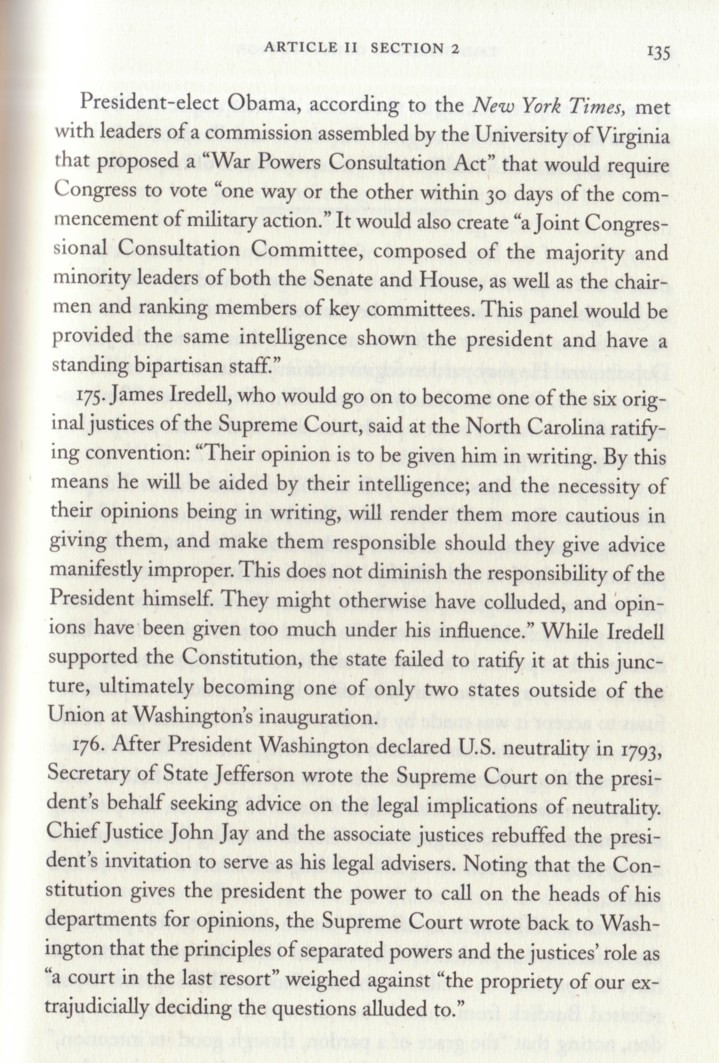
Page 133 Lincoln's
[War Time]
Emancipation
Proclamation
Justification
Page 134 Lincoln's
Supreme Court On
Presedential Power
To Supress Insurection
Page 135
Obama's War Powers
Consultation Act &
Washington's Neutrality


Section 3 - State of the Union, Convening Congress

He shall from time to time give to the Congress Information of the State of the Union, and recommend to their Consideration such Measures as he shall judge necessary and expedient; he may, on extraordinary Occasions, convene both Houses, or either of them, and in Case of Disagreement between them, with Respect to the Time of Adjournment, he may adjourn them to such Time as he shall think proper; he shall receive Ambassadors and other public Ministers; he shall take Care that the Laws be faithfully executed, and shall Commission all the Officers of the United States.


The Citizen's Constitution: An Annotated Guide by Seth Lipsky

Page 144 
Teddy Roosevelt,
Eisenhower,
& Clinton,
Recesss Apointments
Page 145 The
Presidential
History & Gap
In The State of
The Union Address


Section 4 - Disqualification

The President, Vice President and all civil Officers of the United States, shall be removed from Office on Impeachment for, and Conviction of, Treason, Bribery, or other high Crimes and Misdemeanors.

Article 1 - The Legislative Branch


Section 1 - The Legislature

All legislative Powers herein granted shall be vested in a Congress of the United States, which shall consist of a Senate and House of Representatives.

Section 2 - The House

The House of Representatives shall be composed of Members chosen every second Year by the People of the several States, and the Electors in each State shall have the Qualifications requisite for Electors of the most numerous Branch of the State Legislature.

No Person shall be a Representative who shall not have attained to the Age of twenty five Years, and been seven Years a Citizen of the United States, and who shall not, when elected, be an Inhabitant of that State in which he shall be chosen.

Representatives and direct Taxes shall be apportioned among the several States which may be included within this Union, according to their respective Numbers, which shall be determined by adding to the whole Number of free Persons, including those bound to Service for a Term of Years, and excluding Indians not taxed, three fifths of all other Persons. (modified by the 14th Amendment, section 2.) 

The Three Fifths Clause

Professor Walter Williams

"It was slavery's opponents who succeeded in restricting the political power of the South by allowing them to count only three-fifths of their slave population in determining the number of congressional representatives. The three-fifths of a vote provision applied only to slaves, not to free blacks in either the North or South."
[ChristianAnswers.net]
The three-fifths clause was not a measurement of human worth; it was an attempt to reduce the number of pro-slavery proponents in Congress. By including only three-fifths of the total numbers of slaves into the congressional calculations, Southern states were actually being denied additional pro-slavery representatives in Congress. 

The idea of counting slaves as 3/5ths a person was apposed by the South because it diminished representation and supported by abolitionist because the logical fallacy was thought to perhaps end slavery.
While there were a few Founding Fathers who were pro-slavery, the truth is that it was the Founders who were responsible for planting and nurturing the first seeds for the recognition of black equality and for the eventual end of slavery.

The actual Enumeration shall be made within three Years after the first Meeting of the Congress of the United States, and within every subsequent Term of ten Years, in such Manner as they shall by Law direct. The Number of Representatives shall not exceed one for every thirty Thousand, but each State shall have at Least one Representative; and until such enumeration shall be made, the State of New Hampshire shall be entitled to chuse three, Massachusetts eight, Rhode Island and Providence Plantations one, Connecticut five, New York six, New Jersey four, Pennsylvania eight, Delaware one, Maryland six, Virginia ten, North Carolina five, South Carolina five and Georgia three.
When vacancies happen in the Representation from any State, the Executive Authority thereof shall issue Writs of Election to fill such Vacancies.

The House of Representatives shall chuse their Speaker and other Officers; and shall have the sole Power of Impeachment.

Section 3 - The Senate

The Senate of the United States shall be composed of two Senators from each State, chosen by the Legislature thereof (superseded by 17th Amendment, section 1.) for six Years; and each Senator shall have one Vote.

Immediately after they shall be assembled in Consequence of the first Election, they shall be divided as equally as may be into three Classes. The Seats of the Senators of the first Class shall be vacated at the Expiration of the second Year, of the second Class at the Expiration of the fourth Year, and of the third Class at the Expiration of the sixth Year, so that one third may be chosen every second Year; and if Vacancies happen by Resignation, or otherwise, during the Recess of the Legislature of any State, the Executive thereof may make temporary Appointments until the next Meeting of the Legislature, which shall then fill such Vacancies. (superseded by the 17th Amendment, section 2.)

No person shall be a Senator who shall not have attained to the Age of thirty Years, and been nine Years a Citizen of the United States, and who shall not, when elected, be an Inhabitant of that State for which he shall be chosen.

The Vice President of the United States shall be President of the Senate, but shall have no Vote, unless they be equally divided.

The Senate shall chuse their other Officers, and also a President pro tempore, in the absence of the Vice President, or when he shall exercise the Office of President of the United States.

The Senate shall have the sole Power to try all Impeachments. When sitting for that Purpose, they shall be on Oath or Affirmation. When the President of the United States is tried, the Chief Justice shall preside: And no Person shall be convicted without the Concurrence of two thirds of the Members present.

Judgment in Cases of Impeachment shall not extend further than to removal from Office, and disqualification to hold and enjoy any Office of honor, Trust or Profit under the United States: but the Party convicted shall nevertheless be liable and subject to Indictment, Trial, Judgment and Punishment, according to Law.

Section 4 - Elections, Meetings

The Times, Places and Manner of holding Elections for Senators and Representatives, shall be prescribed in each State by the Legislature thereof; but the Congress may at any time by Law make or alter such Regulations, except as to the Place of Chusing Senators.

The Congress shall assemble at least once in every Year, and such Meeting shall be on the first Monday in December, (superseded by the 20th Amendment, section 2.) unless they shall by Law appoint a different Day.

Section 5 - Membership, Rules, Journals, Adjournment

Each House shall be the Judge of the Elections, Returns and Qualifications of its own Members, and a Majority of each shall constitute a Quorum to do Business; but a smaller number may adjourn from day to day, and may be authorized to compel the Attendance of absent Members, in such Manner, and under such Penalties as each House may provide.

Each House may determine the Rules of its Proceedings, punish its Members for disorderly Behavior, and, with the Concurrence of two-thirds, expel a Member.

Each House shall keep a Journal of its Proceedings, and from time to time publish the same, excepting such Parts as may in their Judgment require Secrecy; and the Yeas and Nays of the Members of either House on any question shall, at the Desire of one fifth of those Present, be entered on the Journal.

Neither House, during the Session of Congress, shall, without the Consent of the other, adjourn for more than three days, nor to any other Place than that in which the two Houses shall be sitting.

Section 6 - Compensation

The Senators and Representatives shall receive a Compensation for their Services, to be ascertained by Law, and paid out of the Treasury of the United States. (modified by the 27th Amendment.) They shall in all Cases, except Treason, Felony and Breach of the Peace, be privileged from Arrest during their Attendance at the Session of their respective Houses, and in going to and returning from the same; and for any Speech or Debate in either House, they shall not be questioned in any other Place.

No Senator or Representative shall, during the Time for which he was elected, be appointed to any civil Office under the Authority of the United States which shall have been created, or the Emoluments whereof shall have been increased during such time; and no Person holding any Office under the United States, shall be a Member of either House during his Continuance in Office.

Section 7 - Revenue Bills, Legislative Process, Presidential Veto

All bills for raising Revenue shall originate in the House of Representatives; but the Senate may propose or concur with Amendments as on other Bills.

Every Bill which shall have passed the House of Representatives and the Senate, shall, before it become a Law, be presented to the President of the United States; If he approve he shall sign it, but if not he shall return it, with his Objections to that House in which it shall have originated, who shall enter the Objections at large on their Journal, and proceed to reconsider it. If after such Reconsideration two thirds of that House shall agree to pass the Bill, it shall be sent, together with the Objections, to the other House, by which it shall likewise be reconsidered, and if approved by two thirds of that House, it shall become a Law. But in all such Cases the Votes of both Houses shall be determined by Yeas and Nays, and the Names of the Persons voting for and against the Bill shall be entered on the Journal of each House respectively. If any Bill shall not be returned by the President within ten Days (Sundays excepted) after it shall have been presented to him, the Same shall be a Law, in like Manner as if he had signed it, unless the Congress by their Adjournment prevent its Return, in which Case it shall not be a Law.

Every Order, Resolution, or Vote to which the Concurrence of the Senate and House of Representatives may be necessary (except on a question of Adjournment) shall be presented to the President of the United States; and before the Same shall take Effect, shall be approved by him, or being disapproved by him, shall be repassed by two thirds of the Senate and House of Representatives, according to the Rules and Limitations prescribed in the Case of a Bill.

Section 8 - Powers of Congress

The Congress shall have Power To lay and collect Taxes, Duties, Imposts and Excises, to pay the Debts and provide for the common Defence and general Welfare of the United States; but all Duties, Imposts and Excises shall be uniform throughout the United States;

The General Welfare Clause

 James Madison, Father of the Constitution, in a Letter to James Robertson 1831-04-20
“With respect to the words “general welfare,” I have always regarded them as qualified by the detail of powers connected with them. To take them in a literal and unlimited sense would be a metamorphosis of the Constitution into a character which there is a host of proofs was not contemplated by its creators. If the words obtained so readily a place in the “Articles of Confederation,” and received so little notice in their admission into the present Constitution, and retained for so long a time a silent place in both, the fairest explanation is, that the words, in the alternative of meaning nothing or meaning everything, had the former meaning taken for granted.”
Original Intent and Abuse of the General Welfare Clause by lilpete39 on The 9-12 Project Forum
In his “Report on Manufactures” (1791), Hamilton disposed that the clause enlarged the power of Congress to tax and spend in the name of the general welfare as well as for other purposes not falling within other enumerated powers, a distinct power not delegated anywhere in the original intent, meaning and the written word of the Constitution.

    The General Welfare Clause was first interpreted in United States v. Butler in 1936, the beginning of the shredding of the Constitution by justices appointed by FDR and the onslaught of the progressive agenda. Justice Owen Roberts writing the majority opinion, agreed with Hamilton’s interpretation and held that the general welfare language in the taxing and spending clause constituted a seperate grant of power to Congress in areas over which it was not granted direct regulatory control.

To borrow money on the credit of the United States;

To regulate Commerce with foreign Nations, and among the several States, and with the Indian Tribes;

To establish an uniform Rule of Naturalization, and uniform Laws on the subject of Bankruptcies throughout the United States;

To coin Money, regulate the Value thereof, and of foreign Coin, and fix the Standard of Weights and Measures;

To provide for the Punishment of counterfeiting the Securities and current Coin of the United States;

To establish Post Offices and Post Roads;

To promote the Progress of Science and useful Arts, by securing for limited Times to Authors and Inventors the exclusive Right to their respective Writings and Discoveries;

 The Copyright Clause


 Congress recodified copyright in 1909, it dropped the limiting language, and protected all “works of art”—whether “fine” or not.

Justice Oliver Wendell Holmes, Bleistein v. Donaldson Lithographing Co. ( 1903)
“It would be a dangerous undertaking for persons trained only to the law to constitute themselves final judges of the worth of pictorial illustrations[1], outside of the narrowest and most obvious limits. At the one extreme some works of genius would be sure to miss appreciation. Their very novelty would make them repulsive until the public had learned the new language in which their author spoke. It may be more than doubted, for instance, whether the etchings of Goya or the paintings of Manet would have been sure of protection when seen for the first time. At the other end, copyright would be denied to pictures which appealed to a public less educated than the judge. Yet if they command the interest of any public, they have a commercial value—it would be bold to say that they have not an aesthetic and educational value—and the taste of any public is not to be treated with contempt.” 
[1] - http://www.edwardsamuels.com/illustratedstory/isc6.htm

To constitute Tribunals inferior to the supreme Court;

To define and punish Piracies and Felonies committed on the high Seas, and Offenses against the Law of Nations;

To declare War, grant Letters of Marque and Reprisal, and make Rules concerning Captures on Land and Water;

To raise and support Armies, but no Appropriation of Money to that Use shall be for a longer Term than two Years;

To provide and maintain a Navy;

To make Rules for the Government and Regulation of the land and naval Forces;

To provide for calling forth the Militia to execute the Laws of the Union, suppress Insurrections and repel Invasions;

To provide for organizing, arming, and disciplining, the Militia, and for governing such Part of them as may be employed in the Service of the United States, reserving to the States respectively, the Appointment of the Officers, and the Authority of training the Militia according to the discipline prescribed by Congress;

To exercise exclusive Legislation in all Cases whatsoever, over such District (not exceeding ten Miles square) as may, by Cession of particular States, and the acceptance of Congress, become the Seat of the Government of the United States, and to exercise like Authority over all Places purchased by the Consent of the Legislature of the State in which the Same shall be, for the Erection of Forts, Magazines, Arsenals, dock-Yards, and other needful Buildings; And

To make all Laws which shall be necessary and proper for carrying into Execution the foregoing Powers, and all other Powers vested by this Constitution in the Government of the United States, or in any Department or Officer thereof.

Section 9 - Limits on Congress

The Migration or Importation of such Persons as any of the States now existing shall think proper to admit, shall not be prohibited by the Congress prior to the Year one thousand eight hundred and eight, but a tax or duty may be imposed on such Importation, not exceeding ten dollars for each Person.

The privilege of the Writ of Habeas Corpus shall not be suspended, unless when in Cases of Rebellion or Invasion the public Safety may require it.

No Bill of Attainder or ex post facto Law shall be passed.

(No capitation, or other direct, Tax shall be laid, unless in Proportion to the Census or Enumeration herein before directed to be taken.) (Section in parentheses clarified by the 16th Amendment.)

No Tax or Duty shall be laid on Articles exported from any State.

No Preference shall be given by any Regulation of Commerce or Revenue to the Ports of one State over those of another: nor shall Vessels bound to, or from, one State, be obliged to enter, clear, or pay Duties in another.

No Money shall be drawn from the Treasury, but in Consequence of Appropriations made by Law; and a regular Statement and Account of the Receipts and Expenditures of all public Money shall be published from time to time.

No Title of Nobility shall be granted by the United States: And no Person holding any Office of Profit or Trust under them, shall, without the Consent of the Congress, accept of any present, Emolument, Office, or Title, of any kind whatever, from any King, Prince or foreign State.

Section 10 - Powers prohibited of States

No State shall enter into any Treaty, Alliance, or Confederation; grant Letters of Marque and Reprisal; coin Money; emit Bills of Credit; make any Thing but gold and silver Coin a Tender in Payment of Debts; pass any Bill of Attainder, ex post facto Law, or Law impairing the Obligation of Contracts, or grant any Title of Nobility.

No State shall, without the Consent of the Congress, lay any Imposts or Duties on Imports or Exports, except what may be absolutely necessary for executing it's inspection Laws: and the net Produce of all Duties and Imposts, laid by any State on Imports or Exports, shall be for the Use of the Treasury of the United States; and all such Laws shall be subject to the Revision and Controul of the Congress.

No State shall, without the Consent of Congress, lay any duty of Tonnage, keep Troops, or Ships of War in time of Peace, enter into any Agreement or Compact with another State, or with a foreign Power, or engage in War, unless actually invaded, or in such imminent Danger as will not admit of delay.

Color Coding

The Constitution Itself
Notes on the Constitutional Convention and Federalist Papers
My Writings

The Writing of Another
The Writing or Ideas of Another written or reference by that first other 
Seth Lipsky's Guide
The Writings of others in Lipsky's Guide
______________________________________

Wednesday, December 21, 2011

Jefferson's Notes on the State of Virginia, Query XVIII: Manners 1781

The particular customs and manners that may happen to be received in that state?
It is difficult to determine on the standard by which the manners of a nation may be tried, whether catholic, or particular. It is more difficult for a native to bring to that standard the manners of his own nation, familiarized to him by habit. There must doubtless be an unhappy influence on the manners of our people produced by the existence of slavery among us. The whole commerce between master and slave is a perpetual exercise of the most boisterous passions, the most unremitting despotism on the one part, and degrading submissions on the other. Our children see this, and learn to imitate it; for man is an imitative animal. This quality is the germ of all education in him. From his cradle to his grave he is learning to do what he sees others do. If a parent could find no motive either in his philanthropy or his self-love, for restraining the intemperance of passion towards his slave, it should always be a sufficient one that his child is present. But generally it is not sufficient. The parent storms, the child looks on, catches the lineaments [1] of wrath, puts on the same airs in the circle of smaller slaves, gives a loose to his worst of passions, and thus nursed, educated, and daily exercised in tyranny, cannot but be stamped by it with odious peculiarities. The man must be a prodigy who can retain his manners and morals undepraved by such circumstances. And with what execration [2] should the statesman be loaded, who permitting one half the citizens thus to trample on the rights of the other, transforms those into despots, and these into enemies, destroys the morals of the one part, and the amor patriae of the other. For if a slave can have a country in this world, it must be any other in preference to that in which he is born to live and labour for another: in which he must lock up the faculties of his nature, contribute as far as depends on his individual endeavours to the evanishment of the human race, or entail his own miserable condition on the endless generations proceeding from him. With the morals of the people, their industry also is destroyed. For in a warm climate, no man will labour for himself who can make another labour for him. This is so true, that of the proprietors of slaves a very small proportion indeed are ever seen to labour. And can the liberties of a nation be thought secure when we have removed their only firm basis, a conviction in the minds of the people that these liberties are of the gift of God? That they are not to be violated but with his wrath? Indeed I tremble for my country when I reflect that God is just: that his justice cannot sleep for ever: that considering numbers, nature and natural means only, a revolution of the wheel of fortune, an exchange of situation, is among possible events: that it may become probable by supernatural interference! The Almighty has no attribute which can take side with us in such a contest.--But it is impossible to be temperate and to pursue this subject through the various considerations of policy, of morals, of history natural and civil. We must be contented to hope they will force their way into every one’s mind. I think a change already perceptible, since the origin of the present revolution. The spirit of the master is abating, that of the slave rising from the dust, his condition mollifying, the way I hope preparing, under the auspices of heaven, for a total emancipation, and that this is disposed, in the order of events, to be with the consent of the masters, rather than by their extirpation [3].

___________________________________________________________________________________

[1] lineaments  an outline, a distinctive feature or characteristic, or contour of a body or figure and especially of a face 
[2] execration the act of cursing or denouncing; also : the curse so uttered.
[3] extirpation To pull up by the roots. Local extermination. 
 
- Source -